
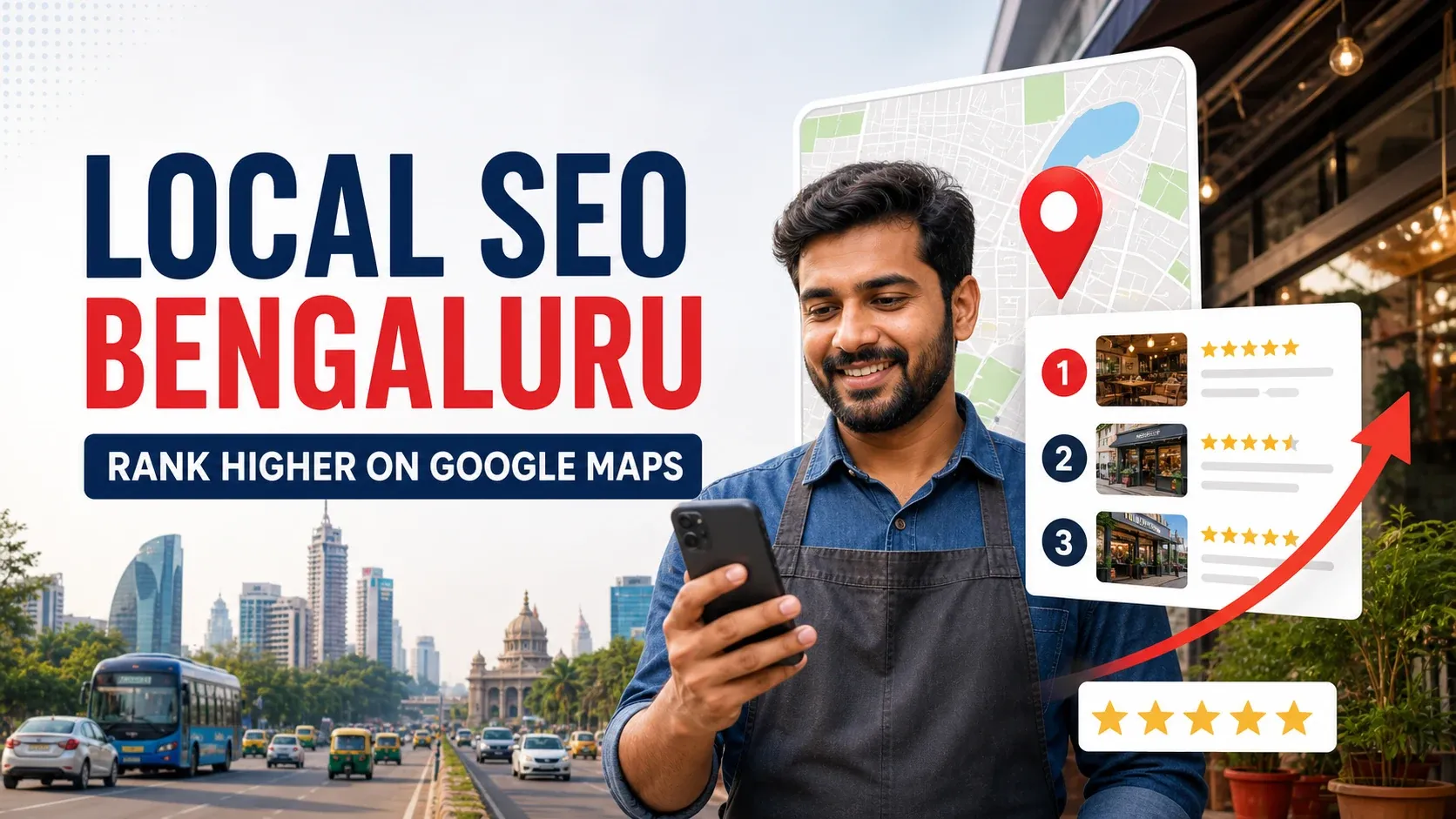
For most businesses in Bengaluru, the map pack matters more than the ordinary search results. It is the block of three listings with a map that appears above the blue links on searches like “dentist near me” or “CA firm in Indiranagar”, and it takes the majority of the clicks on those searches.
It also runs on a different ranking system. You can be the top blue link and be nowhere in the map pack, and the reverse happens just as often.
What actually decides the map pack
Google has been unusually open that local ranking rests on three things: relevance, distance and prominence.
Relevance is how well your listing matches what was searched. This is mostly driven by your Business Profile categories and services, not by your website.
Distance is how far you are from the searcher, or from the area they named. This is the one people underestimate. It is why you can be excellent and still be invisible to someone searching from eight kilometres away.
Prominence is how well known the business appears to be — reviews, mentions elsewhere on the web, and the strength of your website.
You control the first and third. You cannot control the second, and accepting that changes what a sensible local strategy looks like.
1. Get the primary category right
Your primary category is the most powerful setting on the whole profile, and it is a single dropdown that many businesses set once without thinking.
Be specific. “Dental clinic” beats “Clinic”. “Orthodontist” beats “Dental clinic” if that is genuinely your focus. The specific category makes you a stronger match for the searches you actually want, and a weaker match for ones you would never win anyway.
Add secondary categories for the other things you do, but do not stuff them with everything vaguely related — it dilutes the signal.
2. Fill in the parts of the profile everyone skips
Most profiles are half empty. The sections that make a measurable difference:
- Services, listed individually with a description each, rather than one paragraph
- Opening hours, including special hours for public holidays — Bengaluru has plenty
- Photographs that are yours, not stock. The premises, the team, the work
- Products, if you sell anything with a defined price or spec
- Attributes — wheelchair access, parking, women-led, whatever genuinely applies
- The description, written for a person rather than stuffed with keywords
Profiles that get updated also tend to do better than ones left static. Posting occasionally is a low-cost habit worth keeping.
3. Treat reviews as an ongoing process, not a campaign
Reviews affect both whether you appear and whether anyone clicks once you do. Three things matter beyond the star average:
Recency. Twenty reviews from 2023 and none since reads as a business that may have closed.
Replies. Reply to all of them, including the bad ones. A calm, specific reply to a complaint does more for a prospective customer reading it than the complaint does against you.
Language in the review. When customers naturally mention the service and the area — “great root canal treatment, easy to reach from Rajajinagar” — that is a genuine relevance signal. You cannot script this, but you can ask in a way that prompts specifics rather than just a rating.
Ask at the moment the customer is happiest, and make it one tap. A short link sent on WhatsApp converts far better than a request to search for you and scroll.
4. Make your contact details identical everywhere
Your business name, address and phone number appear on your site, your profile, JustDial, IndiaMART, Sulekha and a dozen aggregators you have never visited. Where these disagree, Google’s confidence in your location drops, and confidence feeds ranking.
Bengaluru addresses make this harder than most. The same place might be written as “4th Main Road, 11th Cross”, “4th Main, 11th Cross Rd”, or with the locality first. Pick one exact format and use it everywhere, punctuation included.
5. Build locality pages only where you have something to say
The temptation is to create a page for every area — Malleshwaram, Jayanagar, Koramangala, Whitefield — with the name swapped in. That approach stopped working years ago and now looks like what it is.
A locality page earns its place when it can say something specific: the areas you actually cover from there, the travel realities, work you have done nearby, questions that come up in that market. If you can write three genuinely different paragraphs, build it. If you cannot, do not.
Two strong locality pages beat fifteen thin ones, and they will not drag the rest of the site down with them.
6. Make the website support the profile
The map pack is not sealed off from your website — Google reads the site to understand the business.
Practical things that help: a proper contact page with the address as text rather than only inside an image or a map embed, LocalBusiness structured data with your address and hours, service pages that name the areas you serve, and a site that loads quickly on a phone, because most local searches are mobile and often on the move.
7. Measure the profile separately from the website
Google Business Profile has its own performance data — how many people found you through search versus maps, how many called, asked for directions or clicked through to the site.
Those calls are the point. A local business will often get far more phone calls from the profile than form submissions from the website, and if you only look at website analytics you will conclude local SEO is not working when it is doing most of the work.
A realistic order to do this in
- Claim and verify the profile if you have not
- Fix the primary category
- Fill in services, hours and photographs properly
- Set up a repeatable way of asking for reviews
- Make contact details consistent across the major directories
- Then look at locality pages and website changes
The first four cost nothing but time, and for most businesses they are where the largest gap sits.
When this does not apply
If you sell nationally and customers never come to you, most of this is the wrong priority — you want ordinary organic and paid search instead. If you are in a category where Google shows a booking or aggregator panel above everything — hotels, some clinics, restaurants — the aggregators may matter more than your own profile, and that needs a different plan. And if you are one business trying to appear across the whole city from a single address, the honest answer is that proximity will beat you in most of it, however good the rest of your work is.