
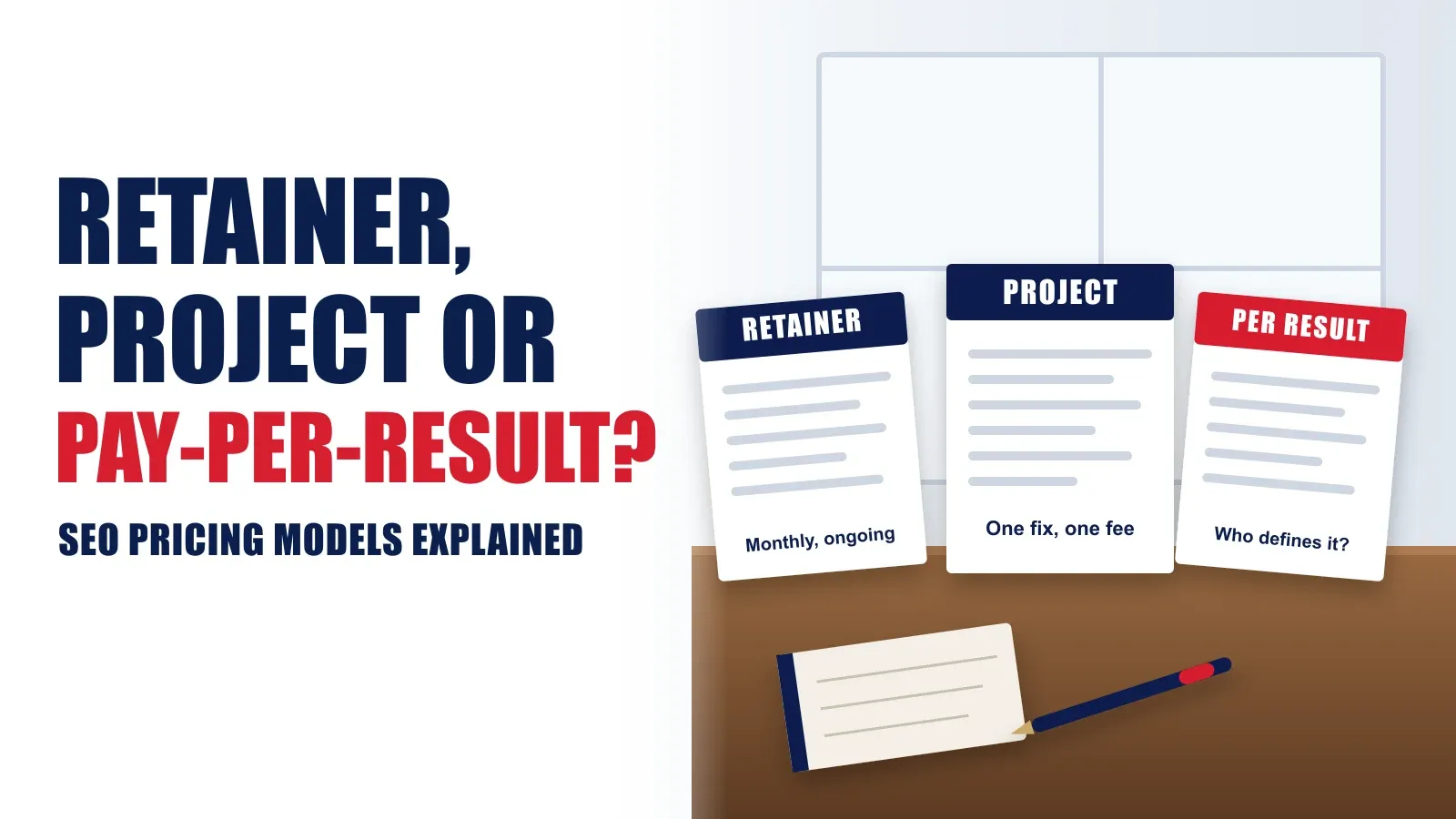
There are three ways to pay for SEO in India: a monthly retainer, a fixed-price project, or a fee tied to results. A retainer suits ongoing growth, a project suits one defined fix, and pay-per-result works only when the result is something you can verify yourself.
If you have not yet seen how much each of these tends to cost, start with how much SEO costs in India. This post covers how the fee is structured, because the model matters as much as the number.
What are the main SEO pricing models?
| Model | What you pay | Best for | Main risk |
|---|---|---|---|
| Monthly retainer | A fixed fee each month for agreed work | Ongoing growth over six months or more | Paying for activity, not outcomes |
| Fixed-price project | One fee for a defined piece of work | A specific problem: migration, speed, clean-up | Scope that is too narrow to fix the real cause |
| Pay-per-result | A fee tied to a measured outcome | Cases where the result is easy to verify | Disputes over what counts as a result |
| Hybrid | Project fee first, then smaller retainer | Sites that need fixing before they can grow | Needs clear hand-over between the two stages |
None of these is the cheapest in every case. The right one is the one where you can see what each rupee buys.
When does a monthly retainer make sense?
A retainer makes sense when you want steady growth in organic enquiries and your site is already in reasonable shape. SEO compounds: this month’s content and links keep working next month, and a retainer pays for the continuing hours that keep that going.
What a good retainer looks like:
- Named monthly work. How many pages reviewed or written, what outreach, what technical checks.
- Reporting on enquiries. Not only rankings.
- A review point. At month three and month six, with an agreed question to answer.
- A one-month notice period.
Where it goes wrong: a vague scope. “SEO services” with no list means the agency decides what to do, and you cannot tell if it was enough.
When is a fixed-price project better?
A project is better when you have one specific problem. A site migration that lost rankings, a slow site, a suspended Business Profile, a set of pages that compete with each other for the same keyword.
The strength of a project is the clear end. You agree the work, the price and what done looks like. The risk is scope: if the real cause sits outside what you agreed, you fix a symptom. Ask the agency to say, in writing, what they would check beyond the list.
Many businesses are better off starting here, because it gives you a first result before you commit to a longer engagement.
What about pay-per-result SEO?
Paying only for results sounds safest, and sometimes it is. But the whole arrangement depends on one question: who defines the result?
Per ranking. The agency is rewarded for the easiest keywords. A page can rank first for a phrase nobody buys on, so the payment proves little.
Per lead. Better, if you can check it. Leads logged in your own form, phone log or WhatsApp inbox are checkable. Leads counted in the agency’s own report are not.
Per traffic. Easiest to inflate. Visitors are not customers.
If you consider this model, agree four things in writing: what counts as a result, where it is measured, who has access to the measurement, and what happens if you disagree.
Is a hybrid the sensible choice?
For many sites, yes. A hybrid starts with a fixed-price project to fix the foundations, such as indexing, titles, page structure, internal links and the Business Profile. It then moves to a smaller retainer to build on them.
The reason it works: a retainer on a site with broken foundations spends its first months doing repair work, which is better priced and scoped as a project. After that, the retainer pays for growth.
How do you choose between them?
Match the model to your situation, not to the cheapest-looking headline.
- You have one clear problem. Choose a project.
- You want steady growth and the site is sound. Choose a retainer.
- The site needs fixing and then growth. Choose a hybrid.
- You are offered pay-per-result. Check you can verify the result yourself, or decline.
- You need enquiries this month. SEO is the wrong tool. Look at Google Ads first.
What should every agreement include?
Whatever the model, ask for these in writing:
- the scope, with named deliverables
- who does the work, and whether you can speak to them
- what is reported and how often
- a notice period of about one month
- ownership of all content and accounts, yours
- what happens at exit
We go through the questions worth asking in how to choose an SEO agency in India.
Where to go from here
If a proposal is on your desk and you cannot tell which model it is, or what it covers, talk to us about your site. We will read it with you and tell you plainly what we would do first, including when the answer is to do it yourself or start with ads. You can see how we approach the work on our on-page SEO service page.